Showing posts with label Ships. Show all posts

Monday, 27 April 2020

New Shipyard shop


As the new website continues now at www.theloftsman.com
The Blog on the new website will be the main source of news from now on and this new Blog will be even better with all the news on Leith Built Ships and so much more, such as the new shipyard shop about to open over there.


Will be opening soon, we have been working on this new concept for a wee while now, with the advent of the virus pandemic this has presented some more unexpected challenges. No more than anyone else has had to contend with but challenges just the same.


All under the logo
They Once Were Shipbuilders
(You will be able to fill in the location with your own preference)
My own particular preference was of course the Henry Robb Shipyard at Leith.

The aim of the shop is to present the customer with unique purchases that you will not find elsewhere. This will be a shop that will be a testament to a lost industry that touched so many people.

The Shipyard Shop will feature many fresh designs which cover an old concept, the concept of building ships.

Powerful industrial images now almost gone, but the memory lingers on, images that now sit very well on every day things from caps, hats to t-shirts to wall coverings.


We are sure that once the Shipyard Shop opens you will find what you are looking for, in a way that no other shop can, as we are also from the industry, an industry that employed so many people not only on this small island nation of ours but all around the World.

http://www.theloftsman.com/ship-photo-s


We will feature superb museum quality ship models covering many of the greatest ships ever to grace the seven seas.
We feature the Ship Beautiful above otherwise known as RMS Aquitania
Thes are not kits but fully assembled models shipped in sturdy containers to your door and ready to display. Some have LED lighting inside for a tremendous night-time effect.

Many of our original designs can be personalised so that you can input your own personal favourite, so please keep a look out for this happening, keep checking back here on the Blog, and on the main website.
Thanks to all and keep safe during these trying times.


They Once Were Shipbuilders
*LEITH*

We hope you like the small taster of some of the many products that we shall soon be able to offer on the “Brand New” Shipyard Shop.

Bear with us as I am sure we shall open this pretty soon.

Why not have a look at some of my Amazon stuff on the Blog while we wait on the shop opening, below you will find a really neat 3 in 1 Document Camera from Amazon.

OKIOCAM T Plus: The Unique 3-In-1 Document Camera

Saturday, 14 December 2019

New Book - they Once Were Shipbuilders. I


SS Sirius was the Leith Built Ship that crossed the mighty Atlantic being the very first such vessel to cross under steam power alone.

Many more Leith "Firsts" can be found in the new book on an almost forgotten maritime past.

Leith-Built Ships Vol. I 

They Once Were Shipbuilders


Make it a xmas gift but dont just take my word for it, have a look at some of the first reviews as shown below.


Available from most good book stores or direct from the publishers.

http://www.whittlespublishing.com/They_Once_Were_Shipbuilders

The book is also available on Amazon and can be delivered anywhere around the world.

https://www.amazon.co.uk/They-Once-Were-Shipbuilders-Leith-Built/dp/1849954437/ref=sr_1_1?keywords=Once+Were+Shipbuilders&qid=1576318172&sr=8-1


Saturday, 5 July 2014

"Letter From America" - Leith Shipyards and The Proclaimers


This contribution is from our featured writer Jenny Buxton as there is just not enough time to keep contributing to the Blog on a daily basis and this we feel will help to keep the Blog relevant and interesting.

The views expressed are the writers alone and are not necessarily the views of Leith Built Ships (although we do agree with some of them?)


"Letter From America" - Leith Docks and The Proclaimers
In 1987, Leith Docks were treated to an experience quite unlike anything else it had undergone in its long career – and that’s saying quite something, as all manner of curios passed through the Robbs yard during its lifetime. With a musical accompaniment and a blisteringly poignant set of lyrics, images of the shipyard were broadcast into the living rooms of hundreds. Thanks to Scottish twin duo ‘The Proclaimers’ [1]Henry Robb's shipyard, right at the end of its life, had a brush with pop-stardom.
 Porno
Ecomonic Depression
It was used in the video to ‘Letter From America’, a song which speaks of economic migration from Scotland due to unemployment, depression, and even enforced eviction – all experiences with which Scotland has had a long experience. Leith Docks featured heavily in the video as an example of the kind of traditional Scottish industry which was, in the eighties, being lost – necessitating the emigration of former employees. At the time, the shipyard had been closed for four years and was falling derelict. As such, it stood as a painful and marked reminder of all that Scotland had lost and was in the process of losing. This was the era in which “Trainspotting” [2]  - that seminal novel of disaffected Scottish youth – is set. The era of Thatcherism, of job-losses, of clashes between all-powerful money-worshipping capitalists and the working man, of anger, of riots, of growing consumerism and shrinking opportunities. The Herald describe the eighties as an era in which “Scotland’s industrial heartlands were ripped out and thrown on the scrapheap” [3], and a lot of anger remains today at what is still seen as an irrevocable loss to Scotland.


Family Connection
Henry Robb’s yard was used in the video to the track partly because the father of Charlie and Craig Reid who make up the Proclaimers had worked in the yard. Indeed, the pair were born in Leith, and thus had a strong association with the yard. The working class, working man’s culture into which they were born, and which was being steadily eroded by the economic policies of the time as they grew up, would strongly influence their music. Much of their tracks are politically motivated, with a strong Scottish-cultural influence, and the depression of the eighties certainly left its mark on the brothers. Craig told the Scotsman in a recent interview, “We know what it’s like to have no money and to be at the mercy of other people….I remember spending the whole day with Charlie at the DSS, queuing for housing benefit, crowded in like cattle, and you had no say, no economic power” [4]. The family moved around in search of work as places like Robb’s closed and evicted their employees, leaving the twins well-placed to pen a track like ‘Letter From America’, which harkens to economically enforced Scots migration.
 Australians
A Deep Scar
The eighties were a period which have left a deep scar upon not only the Scots national consciousness, but also the economic viability of Scotland as a whole. Arguably, the destruction of the shipyards and other manufacturing and industrial enterprises began a process of wholesale denigration which would be furthered twenty years later, with the 2008 recession from which we are only now emerging. Deprived of steady income at dockyards and the like, a whole swathe of society learned instead to rely upon high-interest loans and state handouts for survival. When the credit industry collapsed in 2008, it took with it not only a whole host of jobs and industries which relied upon it for survival, it also pulled the (already threadbare) rug out from beneath the feet of struggling Scots. Austerity measures like benefit cuts rendered the situation yet more desperate. Unable to turn to places like Henry Robb’s shipyard to get work, these people slipped between the cracks, often ending up desperate and homeless. The Scottish Government state that, as of 2014, “recovery in the Scottish economy is progressing and consolidating” [5], and the credit industries are beginning to reach out to people once again, with sites like CompareNI offering “many secured and unsecured loans” [6] to those in need of a cash injection, but for many this comes too little too late. It’s a recovery, furthermore, led almost entirely by consumer activity rather than industrial activity. Instead of pulling itself up through its own industrial infrastructure, Scotland is being wonkily hauled back into the black through patchy and irregular consumer spending patterns. It is not an ideal situation.
 
120x60 Last Minute New York Deals!
Sorely Missed
In its heyday, Robb’s shipbuilding company employed thousands, and left all of those employees with a viable trade which they could ply anywhere in the world, should they so wish. These skilled people were a great boon to whatever country they lived in. Unfortunately, as the Scottish shipyards steadily fell to Thatcher’s onslaught, that country was Scotland less and less. Although many Scots emigrants sent money home - banks lie HSBC [7] which provided international transfer services did particularly well during the eighties - the dearth of opportunities for people to use their skills naturally lead to an evacuation of those skills from Scotland. They have never returned. Places like Robb’s yard at Leith Docks are sorely missed.

Australian Migrant Ships Australian Migrant Ships
In 1945 Arthur Calwell announced a new immigration policy for Australia requiring an influx of 70,000 migrants a year, and it was hoped that all of them would come from Britain. When insufficient Britons applied the Australian government looked to Italy and Greece and then to refugee camps across Europe. This book looks at the ships that brought these migrants to Australia - some that were never designed to carry passengers or to travel great distances - and their place in maritime and Australian history.

[2] Irvine Welsh, "Trainspotting", Random House
[3] Ian MacWhirter, "Can Scotland escape the killer zombies?", Herald Scotland, Feb 2013
[4] Janet Christie, "Interview: The Proclaimers still have miles to walk", The Scotsman, July 2013
[6] Compare, "Compare Loans"

Monday, 16 June 2014

PORTSMOUTH SHIPYARD for RENT


WELL I ALMOST FELL OF MY HORSE WHEN THIS ONE DROPPED INTO MY EMAIL INBOX
Expedia's Top Deals
Looks like the MOD are looking for someone with a good business plan and perhaps some forward orders to complete, to take over the running of this famous old shipyard, with a history going back in the building of ships almost as far back as the shipyards of Leith, with a highly skilled workforce lets hope that someone can come in and keep the men working.

You can find out all about it at the following website


The Royal Navy Since 1815 The Royal Navy Since 1815
Eric Grove provides a short history of the Royal Navy over the last two hundred years, synthesizing the new work on the subject that has radically transformed our understanding of the story of British naval development.


Thursday, 12 June 2014

World Cup Brazil 2014


Today marks the start of the biggest sporting event on the Planet the “World Cup”
 A two week extravaganza of the World’s best Football,

 or as our North American cousins call it Soccer.

With the first game today featuring the host nation of Brazil, so what’s the connection between the Leith Shipyards of Henry Robb Ltd and indeed the previous shipyards on the same part of Leith waterfront? and the country of Brazil.

Well we can start with the ships first, and many a ship built at Leith has been a visitor to the long coastline of Brazil the 5th largest country in the world and now a large player in the shipbuilding field as well.


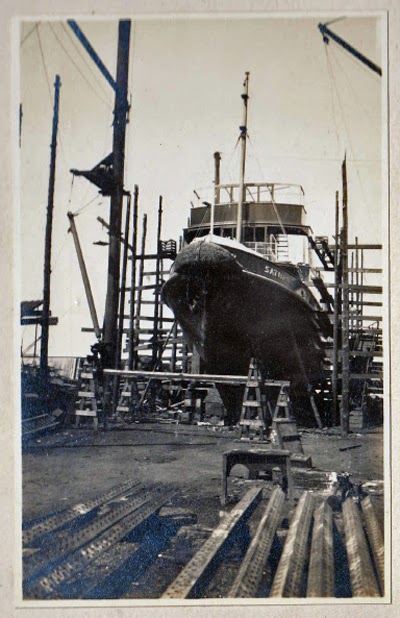
SATURNO Ship No 81 ready to launch at the Leith Shipyards of Henry Robb Ltd in 1928


Apart from many of the sailing ships that were built at the Leith Shipyards of Ramage and Ferguson shipbuilders there is also the famous old salvage tug SATURNO this tug was the fore runner of all the very large and powerful seagoing tugs built at Leith and she was a very well known sight at her home port of Santos, which just happens to be the home city of the team that Pele played for arguably the finest footballer ever.

Football and the shipyards of Leith have always had a close relationship and more so with the team associated with Leith a team right now in some decline it has to be said and not without there troubles to seek that team being Hibernian Football Club or Hibs as the locals call the first team in green in Scotland.

A few of the former players were employed in the shipyards with the most famous of them being the mercurial winger Gordon Smith the only player to win three league titles with three different teams he was that good.
Gordon was employed in the Mould Loft at the Henry Robb yard during World War II
He was also part of the most successful side that Hibernian ever had and played during the 1950’s as part of a forward line that was known as the “Famous Five” this team were invited to take part in a tournament 61 years ago in the country now hosting the World Cup 2014 and for more on this I reproduce a piece from the official Hibernian website which can be found at


http://www.hibernianfc.co.uk/


As you will see there is quite a link between Hibernian Football Club, the Leith Shipyards and Brazil and I have taken the liberty of adding in some of my own comments in brackets.


Flashback: Hibernian in Rio


 11 Jun 2014


Famous Five at the Maracana - 61 years on...

On the eve of the 20th FIFA World Cup, all eyes will now be on host nation, Brazil and the tournament also coincides with the 61-year anniversary of Hibernian's ground-breaking trip to Rio de Janeiro; when the Maracana fell in love with the Famous Five.

Elegant, flamboyant, entertaining and aesthetically pleasing, (a bit like some of the ships built at the Leith Shipyards, while some of the ships were a bit more workman like and could never be called elegant they were no less built for purpose unlike the present day team at Easter Road) Hibernian had won the Scottish championship during the 1951/52 season in emphatic style.

Bright and adventurous, Hibernian, fielding the feted forward line of Gordon Smith, Bobby Johnstone, Lawrie Reilly, Eddie Turnbull and Willie Ormond, had also won over a sea of admirers because of their captivating brand of exhilarating and fast-moving football.

The sport's popularity in Brazil had exploded and there was a particular fascination with British football, thus Hibernian, recognised as the great entertainers of the Scottish game, were invited to participate in the Octagonal Rivadavia Correa Meyer in June 1953.

An overseas summer tour wasn't uncharted territory for a club famed for its pioneering spirit; there had already been visionary forays into Denmark, Austria, Germany, Norway, Belgium, France and Czechoslovakia stretching as far back as 1921.

As the late Lawrie Reilly said: "The Hibs were a great touring side and in the close season we always travelled away on tour. Hibs were the team to play for if you wanted to see the world."

Hibernian's squad, managed by Hugh Shaw, flew from Edinburgh to Rio, albeit via five stop-offs, during an epic journey across to South America.

When the team landed, Hibernian were greeted by an enthusiastic Brazilian crowd - keen to be entertained and educated by a truly formidable group of players.

Hibernian were scheduled to play in an eight-team competitive tournament featuring Brazil's Vasco Da Gama, Botafogo, Fluminese, Sao Paulo and Corinthians, Portugal's Sporting Lisbon and Uruguay's Nacional.

The tournament, organised by the Brazilian FA, was dubbed the unofficial 'World Club Championship' and Hibernian's group contained Vasco Da Gama, Botafogo and Fluminese with all matches staged at the Maracana.

In the opening match against eventual tournament winners, Vasco Da Gama, Hibernian recorded a creditable 3-3 draw in searing heat.

Hibernian's goals were a trademark 'cannonball' shot from powerful inside forward Eddie Turnbull and two from prolific centre-forward Reilly - the second scored in the final minute of the contest.
To read more on this story see the official Hibernian website


The club's next fixture was against Botafogo, who had finished runners-up in the previous year's intercontinental club tournament held in Rio, six days later at the Maracana.

The 30,000 crowd were instantly impressed by Hibernian's magnificent number seven, Gordon Smith - his absolute mastery of the ball and magical spontaneity on the pitch struck an immediate chord with the Brazilian public.

With his perfect balance, athleticism and acute intelligence, Smith was a phenomenal all-round footballer and his performances in the Rio heat elevated him to a more exalted plane - it placed him among the greatest players in the world. The Rio crowd recognised his class and duly worshipped him.

But despite producing some enchanting passages of play in the stifling heat, Hibernian lost 3-1 - the consolation goal scored by Reilly, who had only hours previously been confined to a hospital bed after suffering from acute sickness.

Nevertheless the reaction to the match, which had been shown live on television in Brazil, was overwhelmingly positive - Hibernian had played the game beautifully and for that they were warmly applauded.

The final group game against Fluminese ended in a 3-0 loss six days later - Hibernian again struggling to acclimatise to the intense heat of the Maracana.

Overall the tournament had ended unproductively, but it had underlined the ambitious and progressive nature of Hibernian, thus paving the way through for the club to eventually become the first British team to compete in European competition in 1955.


Hibernian had also left a lasting impression on the way the game subsequently developed tactically in Brazil - the attack-minded, adaptable and exciting style widely admired amongst the country's football community.

In fact, a Brazilian football encyclopaedia published in the late 1960s dedicated an entire chapter to Hibernian's cavalier style of play.

An extract from the book said: "Hibernian played an interchanging positional game that bamboozled their opponents and delighted the watching aficionados, and were included (in the tournament) because at the time they were at the forefront of the British game and brought to it a style that was original for those times."

Hibernian's involvement in the Octagonal Rivadavia Correa Meyer Tournament took place six decades ago, but the memory marches on.

So there you have it the link between today’s World Cup 2014 being held in Brazil and the Leith Shipyards. I could have also added that football in fact really took off in Brazil originally with all thanks to a Scot but that is another story and I cannot really justify going into this safe to say that yet another World Cup starts without my own country being involved in it so we can only watch from afar like kids watching the television through the shop window, not invited again, so this Scot will be shouting for Brazil.


Thursday, 5 June 2014

D-Day 70 years on.


June 6th 1944 – The D-Day Landings


Operation Neptune

Was the code name given to the naval group’s task on this momentous day in 1944. As the remaining survivors of this epic day gather in the U.K. and over in France we salute them.

Operation Neptune
 

The protection of NEPTUNE from enemy counter action was essential to the success of the operation. Allied forces were most vulnerable to enemy counter action when they were embarked and at sea. Some 6,900 allied vessels, carrying approximately nine army divisions with full combat equipment, were at sea at one time. These ships were formed into around 75 convoys and groups, passing along narrow coastal lanes, moving across the channel through the narrow mine-swept channels of the allotted areas for the convoys or crowded into the congested confines of the assault area.

You will find many more books and information on this day and so many more at our Maritime Library at Ships and the Sea

Had the enemy not been deterred by a comprehensive program of defence capability in the form of escort ships and of course command of the air, this enormous armada would have presented to enemy air and naval forces a very profitable target.

The largest assembly of Ships and amphibious forces ever seen were to retake Europe from the clutches of the Nazi.

Operation Neptune Operation Neptune
Long-awaited, the Normandy landings were the largest amphibious operation in history. Success was achieved by the advent of specialised landing craft, first seen in the landings in North Africa, heavy naval firepower and the creatiojn of two artificial harbours, each the size of the port of Dover, and an underwater pipeline. Operation Neptune: The Prelude to D-Day tells the story of this incredible feat using eye-witness accounts of the landings and the breaching of Hitler's famed 'Atlantic Wall'. David Wragg explores the earlier Allied and Axis experiences with amphibious operations and the planning for Neptune and Overlord. Revealing the naval support neede once the armies were ashore and before continental ports could be captured and cleared of mines, with operations such as minesweeping off the Normandy coast which led to one of the worst 'friendly fire' incidents of the war. The is the must-read book to understand what made D-Day possible.


And of course along with the many ships involved where some that were built at the Leith Shipyards of Henry Robb Ltd.
Without the amazing job done by the mine-sweepers there could have been no landing and one of the lead ships was the minesweeper HMS SIDMOUTH Ship No 310 built at the Leith Shipyards of Henry Robb Ltd, yet another of the small ship Navy.
 
The ships crest of HMS SIDMOUTH a Bangor Class Minesweeper built at Leith

Ships such as HMS PINK Ship No 318 amongst many as this battle did not just last for one day but stretched out for something like 6 weeks before the establishment of forces in Normandy had the capability to make the break out of the Normandy region on the roads that lead into the heart of Germany.

HMS PINK the final Flower Class Corvette built at the Leith Shipyards of Henry Robb Ltd
as Ship No 318
Damaged by U988 27th-29th July 1944 and was regarded as a constuctive total loss.
The Uboat was sunk 2 days later

Not only warships but also some of the Bustler Class tugs were involved with the gigantic task of towing the huge mulberry harbours over the channel and into position to enable the supply of the ground forces, along with the massive drums that carried the oil pipeline to the French Coast.

The Bustler Class Tugs such as BUSTLER and SAMSONIA seen here after the war had there part to play in the invasion plans to re-take Europe in 1944
 
Operation Overlord
Operation Overlord, the Allied codename for the invasion of Normandy, involved more than 150,000 men and 6,939 ships.  It consisted of American, British, Canadian, Polish, and Free French Armies under command of General Eisenhower, the Supreme Commander of the Allied Expeditionary Force (the choice of Eisenhower was officially made by President Roosevelt in December 1943, and agreed upon by the British).
The Deputy Supreme Commander of the invasion was British Air Chief Marshal Arthur W. Tedder, who had been the commander of the Allied Air Forces in the Mediterranean.  While British Admiral Bertram H. Ramsay, was appointed naval commander.  He had conducted the evacuation at Dunkirk and also planned the Torch landing in North Africa.  British Air Chief Marshal Trafford L. Leigh-Mallory was appointed as commander of the air forces.

Bernard Montgomery was chosen as the ground forces' commander. 

Saturday, 24 May 2014

Why is there no Leith Built Ships Official Website funded by Edinburgh Council

It says it all in the heading folks, just why is there no official website funded by Edinburgh Council to show off the history of the many fine ships built at Leith, this question I keep asking myself and it was the main reason why I started up this Blog and my website at www.leithshipyards.com
This has all been carried out by myself with lots of input from interested others of course but all the work of putting everything together is by me and the cost of such is borne by myself as well.
It really ticks me off when I see the great job done by Aberdeen Council, funded by no less than the Heritage Lottery fund to showcase the merits of the very fine and many ships built at Aberdeen as well, so why is most of the heritage of the Leith shipyards locked away in the dusty archives of the Archives of Scotland where no one gets to see it, unless you make an appointment of course and pay for the privilege.

Skagboys
Even ex workers are no exception and anyone would think that the Archives actually owned the information, this information should be out there for all to access, yet another reason for my setting up the website.
Is this yet another instance of the ineptitude of the Council in Edinburgh, just because it in fact features ships built at Leith, I repeat Leith not Edinburgh (Leith only joined with Edinburgh in the 1920's under a rigged vote and much duress)
So not much I can do about this situation as it would need someone in Leith or Edinburgh to pick this up and run with the project as I no longer live anywhere near.
For anyone interested take a look at the Aberdeen Shipbuilders website for yourself and see what I am speaking about, it is way past time that some money was spent by the Council of Edinburgh to rectify this situation and let people who are interested see what is hidden away (unless you pay of course)
The Leith "Motto"


Who knows perhaps the director of the national archives for Scotland will see this request and respond as they certainly do not respond to any other requests sent in to them, we require an official good website to show the history of the Leith Shipyards and you should be spending some money on this project.


Rant is now over for the week folks, thank you,

perhaps if you feel strongly about this subject you will also contact the National Archives of Scotland and ask them why no official website (such as the Aberdeen one not the existing archive website) showing this great history of a time we shall never see again in the Port of Leith


Saturday, 10 May 2014

SATURNO Ship No 81 - Update

This Ocean going Salvage Tug was the first in a long line of pedigree vessels of this type built at the Leith Shipyards of Henry Robb Ltd, a line of tugs that lead to the two mightiest and most powerful in the world when they were launched at Leith as the LLOYDSMAN and the S.A.WOLRAAD WOLTEMADE in the 1970's.

The SATURNO was built and launched in 1928 and was only taken to be broken up in 2010 safe to say that she had a useful working life of around 75 years quite remarkable for a ship and a testament to the craftsmanship and pride in workmanship that went into her build.
Now thanks to the Grand Son of an old ex Foreman Loftsman at the Henry Robb yard we have lots of information and photographs of the build and sea trials of this fine ship, so our thanks go to Peter Wallace and to his Grand Father William Wallace who had the book originally.

From the original book made for the launch of the SATURNO in 1928

This amazing ship undertook a maiden voyage of more than 9,000 miles towing at first her two satellite vessels which were lighters of 95feet with a 200 grt to Dakar in Senegal, then back to the Canary Islands to pick up 3 crane barges that had first been built at Robb then dis-assembled and re-erected in the Canaries ready to be towed across the Atlantic by the SATURNO to home port of Santos in Brazil.
Fair to say they don't make them like that any more with most ships today lucky of a useful life approaching 30 years before going to the breakers.
 Many more original photographs will go into the forthcoming books on the ships built at Leith

Saturday, 3 May 2014

Movie about HMNZS KIWI

I did say in the last post that we had been working on some interesting projects and one of them is the probable movie going to be made by a couple of New Zealand film makers about the HMNZS KIWI Ship No 315 and her part in the attack on the huge Japanese submarine I-1 which was successfully carried out by KIWI along with her sister ship HMNZS MOA Ship No 314 also built at the Leith Shipyards of Henry Robb.
The movie is going to concentrate on the extraordinary act of bravery carried out by one of her crew as the two small ships took on their formidable foe.
Visit the new e-book library at Ships and the Sea


During the entire battle the Kiwi’s searchlight and signalling lamp were trained on the submarine.  The searchlight was controlled by Leading Signalman Campbell Buchanan at considerable risk to himself.  Into the action Buchanan was hit and although mortally wounded remained at his post uncomplaining until relieved.  He died of his wounds at Tulagi the following day.  This act of courage won him the US Navy Cross and a posthumous mention in dispatches.  . In a fierce action that lasted more than an hour, Kiwi rammed the submarine three times before I-1 finally struck a reef and was wrecked.
 
Look out for updates on this story which reminds me that I need to get some more information about the ship and her dimensions over to the guys in New Zealand (So if you read this Evan I will get it done and sent to you soon)
 
HMNZS KIWI seen in dry-dock after ramming the Japanese Sub I-1 in 1943


Saturday, 29 March 2014

What Happened to THE MILLER

The Miller in winter Ship No 194


The above photograph was sent into the Leith Shipyards website from a lady who lived on this fine old coaster for around 5 years and it has found memories for her and many others which brings me to the question What happened to THE MILLER

Visit the E-Book library of Ships and the Sea

Has she been to the scrap yard or is she still around just wasting away in some back water siding, we are sure that one of our informed readers will be able to let us know, is this very fine example of a Short Sea Coaster still around she was built in 1932 at the Leith Shipyards of Henry Robb Ltd and was one of the many used to ferry freight around the British Isles in the days before road transport took over to block most of our inner city roads and add to the pollution and congestion that we all seem to just take for granted these days, how many trucks were used to replace just one ship such as THE MILLER.

Friday, 31 January 2014

The KOBENHAVN Builders Plate

Representation of a builders plate from the Barque KOBENHAVN built at the Leith Shipyards of Ramage & Ferguson Ltd, 1921


This picture of what may or not have been a builders plate from the unfortunate ship KOBENHAVN Yard No 256 built at the Ramage & Ferguson shipyards at Leith in 1921, when she was lost in the Winter of 1928 has now been assessed by experts in Denmark and in Glasgow and the consensus of opinion is that this particular builders plate is not from the poor ship, although it may have been made as a commemoration of the mysterious loss of the KOBENHAVN with all her 15 crew and 45 cadets.

So one of the great maritime mystery stories continues and perhaps one day we shall find out what happened to this 5 masted Barque 3,901 grt, which was the largest sailing ship ever built in a British shipyard.

Tuesday, 17 August 2010

M.V.KONINI

M.V.KONINI (At her trials in the River Forth)
Ship No 457


The second vessel ordered by the Union Steamship Company of New Zealand, built alongside the M.V.KUMALLA

She was 2007 GRT, with a length B.P. of 250 feet with a beam of 41 feet and 6 inches, and a design draught of 25 feet and 3 inches.

She was similar in size to Navua and Kaimai and was used on the East Coast coastal service. On the introduction of ro-ro ships she and her sisters became redundant and she was sold to Singapore interests in 1971.


Find a lower price and we will beat it!

Sunday, 27 June 2010

H.M.S. CARNARVON BAY

H.M.S.CARNARVON BAY

Ship No 349

Twin screw “Bay Class” Frigate.


Second of the BAY Class Anti-Aircraft Frigate’s initially ordered on 25th January 1943 for build as a LOCH Class Anti-Submarine Frigate, but for which the ordered was changed in 1944. Originally to have been named H.M.S.LOCH MADDY.

She was laid down on 8th June 1944 and launched as H.M.S.CARNARVON BAY by Henry Robb shipyard at Leith on 15th March 1945.

She was launched two months before the war with Germany was to end, but of course the war with Japan continued, until August 1945.

She was the first Royal Navy ship to carry this name she was completed on 20th September 1945

She served in home waters for a few years before being laid up, then she was eventually sold for scrap in 1959.

A short career for a fine ship.

Sunday, 13 December 2009

A Wee bit of History.


The official Henry Robb Shipyard opened up at the end of World War I around 1918.
The yard was closed down by the then Thatcher Government, in there wisdom and wound up around 1984.
This brought to an end over 660 years of Shipbuilding excellence in Leith.
There seems to be a fair amount of information on most of the other Shipyards around at the time in Scotland but as I said before not to much about Henry Robb in Leith, this is a small attempt to rectify this situation just a little bit, so if some of this is wrong or even made up then you will just have to bear with me until we get it correct.
The Company was founded by Henry Robb, a former yard manager for Ramage & Ferguson in 1918.
The Company then expanded through acquisition buying berths fromHawthorns in 1924, the business of Crane & Somerville in 1926 and the yards of Ramage & Ferguson in 1934. The site became known as Victoria Shipyard.
The Company closed its Arbroath and Clyde operations during the 1920's and focused its activities on Leith.
During World War II, Robbs built a large number of naval warships for the Royal Navy, including preparing the designs and building the prototype of the Basset-class anti-submarine /minesweeping trawler.
On 26 February 1940 King George VI and Queen Elizabeth toured the shipyard.
In 1968, Robbs purchased, and amalgamated with, the Caledon Shipbuilding and Engineering Company of Dundee, forming Robb Caledon Shipbuilding. In 1977, under the provisions of the Aircraft and Shipbuilding Industries Act 1977, Robb Caledon was nationalised as part of British Shipbuilders. The Caledon yard in Dundee closed in 1981; Robb's yard in Leith survived two more years, closing in 1983. The land once occupied by Robb's shipyard is now the Ocean Terminal shopping centre, and home to the Royal Yacht Britannia.

Launch of the M.V.Kiatoa for the Union Steamship Co of New Zealand.
Yard No 443