Showing posts with label warships. Show all posts

Saturday, 5 July 2014

"Letter From America" - Leith Shipyards and The Proclaimers


This contribution is from our featured writer Jenny Buxton as there is just not enough time to keep contributing to the Blog on a daily basis and this we feel will help to keep the Blog relevant and interesting.

The views expressed are the writers alone and are not necessarily the views of Leith Built Ships (although we do agree with some of them?)


"Letter From America" - Leith Docks and The Proclaimers
In 1987, Leith Docks were treated to an experience quite unlike anything else it had undergone in its long career – and that’s saying quite something, as all manner of curios passed through the Robbs yard during its lifetime. With a musical accompaniment and a blisteringly poignant set of lyrics, images of the shipyard were broadcast into the living rooms of hundreds. Thanks to Scottish twin duo ‘The Proclaimers’ [1], Henry Robb's shipyard, right at the end of its life, had a brush with pop-stardom.
 Porno
Ecomonic Depression
It was used in the video to ‘Letter From America’, a song which speaks of economic migration from Scotland due to unemployment, depression, and even enforced eviction – all experiences with which Scotland has had a long experience. Leith Docks featured heavily in the video as an example of the kind of traditional Scottish industry which was, in the eighties, being lost – necessitating the emigration of former employees. At the time, the shipyard had been closed for four years and was falling derelict. As such, it stood as a painful and marked reminder of all that Scotland had lost and was in the process of losing. This was the era in which “Trainspotting” [2]  - that seminal novel of disaffected Scottish youth – is set. The era of Thatcherism, of job-losses, of clashes between all-powerful money-worshipping capitalists and the working man, of anger, of riots, of growing consumerism and shrinking opportunities. The Herald describe the eighties as an era in which “Scotland’s industrial heartlands were ripped out and thrown on the scrapheap” [3], and a lot of anger remains today at what is still seen as an irrevocable loss to Scotland.


Family Connection
Henry Robb’s yard was used in the video to the track partly because the father of Charlie and Craig Reid who make up the Proclaimers had worked in the yard. Indeed, the pair were born in Leith, and thus had a strong association with the yard. The working class, working man’s culture into which they were born, and which was being steadily eroded by the economic policies of the time as they grew up, would strongly influence their music. Much of their tracks are politically motivated, with a strong Scottish-cultural influence, and the depression of the eighties certainly left its mark on the brothers. Craig told the Scotsman in a recent interview, “We know what it’s like to have no money and to be at the mercy of other people….I remember spending the whole day with Charlie at the DSS, queuing for housing benefit, crowded in like cattle, and you had no say, no economic power” [4]. The family moved around in search of work as places like Robb’s closed and evicted their employees, leaving the twins well-placed to pen a track like ‘Letter From America’, which harkens to economically enforced Scots migration.
 Australians
A Deep Scar
The eighties were a period which have left a deep scar upon not only the Scots national consciousness, but also the economic viability of Scotland as a whole. Arguably, the destruction of the shipyards and other manufacturing and industrial enterprises began a process of wholesale denigration which would be furthered twenty years later, with the 2008 recession from which we are only now emerging. Deprived of steady income at dockyards and the like, a whole swathe of society learned instead to rely upon high-interest loans and state handouts for survival. When the credit industry collapsed in 2008, it took with it not only a whole host of jobs and industries which relied upon it for survival, it also pulled the (already threadbare) rug out from beneath the feet of struggling Scots. Austerity measures like benefit cuts rendered the situation yet more desperate. Unable to turn to places like Henry Robb’s shipyard to get work, these people slipped between the cracks, often ending up desperate and homeless. The Scottish Government state that, as of 2014, “recovery in the Scottish economy is progressing and consolidating” [5], and the credit industries are beginning to reach out to people once again, with sites like CompareNI offering “many secured and unsecured loans” [6] to those in need of a cash injection, but for many this comes too little too late. It’s a recovery, furthermore, led almost entirely by consumer activity rather than industrial activity. Instead of pulling itself up through its own industrial infrastructure, Scotland is being wonkily hauled back into the black through patchy and irregular consumer spending patterns. It is not an ideal situation.
 
120x60 Last Minute New York Deals!
Sorely Missed
In its heyday, Robb’s shipbuilding company employed thousands, and left all of those employees with a viable trade which they could ply anywhere in the world, should they so wish. These skilled people were a great boon to whatever country they lived in. Unfortunately, as the Scottish shipyards steadily fell to Thatcher’s onslaught, that country was Scotland less and less. Although many Scots emigrants sent money home - banks lie HSBC [7] which provided international transfer services did particularly well during the eighties - the dearth of opportunities for people to use their skills naturally lead to an evacuation of those skills from Scotland. They have never returned. Places like Robb’s yard at Leith Docks are sorely missed.

Australian Migrant Ships Australian Migrant Ships
In 1945 Arthur Calwell announced a new immigration policy for Australia requiring an influx of 70,000 migrants a year, and it was hoped that all of them would come from Britain. When insufficient Britons applied the Australian government looked to Italy and Greece and then to refugee camps across Europe. This book looks at the ships that brought these migrants to Australia - some that were never designed to carry passengers or to travel great distances - and their place in maritime and Australian history.

[2] Irvine Welsh, "Trainspotting", Random House
[3] Ian MacWhirter, "Can Scotland escape the killer zombies?", Herald Scotland, Feb 2013
[4] Janet Christie, "Interview: The Proclaimers still have miles to walk", The Scotsman, July 2013
[6] Compare, "Compare Loans"

Thursday, 5 June 2014

D-Day 70 years on.


June 6th 1944 – The D-Day Landings


Operation Neptune

Was the code name given to the naval group’s task on this momentous day in 1944. As the remaining survivors of this epic day gather in the U.K. and over in France we salute them.

Operation Neptune
 

The protection of NEPTUNE from enemy counter action was essential to the success of the operation. Allied forces were most vulnerable to enemy counter action when they were embarked and at sea. Some 6,900 allied vessels, carrying approximately nine army divisions with full combat equipment, were at sea at one time. These ships were formed into around 75 convoys and groups, passing along narrow coastal lanes, moving across the channel through the narrow mine-swept channels of the allotted areas for the convoys or crowded into the congested confines of the assault area.

You will find many more books and information on this day and so many more at our Maritime Library at Ships and the Sea

Had the enemy not been deterred by a comprehensive program of defence capability in the form of escort ships and of course command of the air, this enormous armada would have presented to enemy air and naval forces a very profitable target.

The largest assembly of Ships and amphibious forces ever seen were to retake Europe from the clutches of the Nazi.

Operation Neptune Operation Neptune
Long-awaited, the Normandy landings were the largest amphibious operation in history. Success was achieved by the advent of specialised landing craft, first seen in the landings in North Africa, heavy naval firepower and the creatiojn of two artificial harbours, each the size of the port of Dover, and an underwater pipeline. Operation Neptune: The Prelude to D-Day tells the story of this incredible feat using eye-witness accounts of the landings and the breaching of Hitler's famed 'Atlantic Wall'. David Wragg explores the earlier Allied and Axis experiences with amphibious operations and the planning for Neptune and Overlord. Revealing the naval support neede once the armies were ashore and before continental ports could be captured and cleared of mines, with operations such as minesweeping off the Normandy coast which led to one of the worst 'friendly fire' incidents of the war. The is the must-read book to understand what made D-Day possible.


And of course along with the many ships involved where some that were built at the Leith Shipyards of Henry Robb Ltd.
Without the amazing job done by the mine-sweepers there could have been no landing and one of the lead ships was the minesweeper HMS SIDMOUTH Ship No 310 built at the Leith Shipyards of Henry Robb Ltd, yet another of the small ship Navy.
 
The ships crest of HMS SIDMOUTH a Bangor Class Minesweeper built at Leith

Ships such as HMS PINK Ship No 318 amongst many as this battle did not just last for one day but stretched out for something like 6 weeks before the establishment of forces in Normandy had the capability to make the break out of the Normandy region on the roads that lead into the heart of Germany.

HMS PINK the final Flower Class Corvette built at the Leith Shipyards of Henry Robb Ltd
as Ship No 318
Damaged by U988 27th-29th July 1944 and was regarded as a constuctive total loss.
The Uboat was sunk 2 days later

Not only warships but also some of the Bustler Class tugs were involved with the gigantic task of towing the huge mulberry harbours over the channel and into position to enable the supply of the ground forces, along with the massive drums that carried the oil pipeline to the French Coast.

The Bustler Class Tugs such as BUSTLER and SAMSONIA seen here after the war had there part to play in the invasion plans to re-take Europe in 1944
 
Operation Overlord
Operation Overlord, the Allied codename for the invasion of Normandy, involved more than 150,000 men and 6,939 ships.  It consisted of American, British, Canadian, Polish, and Free French Armies under command of General Eisenhower, the Supreme Commander of the Allied Expeditionary Force (the choice of Eisenhower was officially made by President Roosevelt in December 1943, and agreed upon by the British).
The Deputy Supreme Commander of the invasion was British Air Chief Marshal Arthur W. Tedder, who had been the commander of the Allied Air Forces in the Mediterranean.  While British Admiral Bertram H. Ramsay, was appointed naval commander.  He had conducted the evacuation at Dunkirk and also planned the Torch landing in North Africa.  British Air Chief Marshal Trafford L. Leigh-Mallory was appointed as commander of the air forces.

Bernard Montgomery was chosen as the ground forces' commander. 

Saturday, 3 May 2014

Movie about HMNZS KIWI

I did say in the last post that we had been working on some interesting projects and one of them is the probable movie going to be made by a couple of New Zealand film makers about the HMNZS KIWI Ship No 315 and her part in the attack on the huge Japanese submarine I-1 which was successfully carried out by KIWI along with her sister ship HMNZS MOA Ship No 314 also built at the Leith Shipyards of Henry Robb.
The movie is going to concentrate on the extraordinary act of bravery carried out by one of her crew as the two small ships took on their formidable foe.
Visit the new e-book library at Ships and the Sea


During the entire battle the Kiwi’s searchlight and signalling lamp were trained on the submarine.  The searchlight was controlled by Leading Signalman Campbell Buchanan at considerable risk to himself.  Into the action Buchanan was hit and although mortally wounded remained at his post uncomplaining until relieved.  He died of his wounds at Tulagi the following day.  This act of courage won him the US Navy Cross and a posthumous mention in dispatches.  . In a fierce action that lasted more than an hour, Kiwi rammed the submarine three times before I-1 finally struck a reef and was wrecked.
 
Look out for updates on this story which reminds me that I need to get some more information about the ship and her dimensions over to the guys in New Zealand (So if you read this Evan I will get it done and sent to you soon)
 
HMNZS KIWI seen in dry-dock after ramming the Japanese Sub I-1 in 1943


Sunday, 20 February 2011

Update to Royal Navy Ships

Recent update on the Leith shipyards website, at the Royal Navy Ships page.
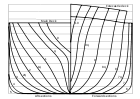
Loch Class Outline


Royal Navy, The Royal Navy, The
Since 1900, the Royal Navy has seen vast operational changes. This book tells the story, not just of victory and defeat, but also of how the Navy has adjusted to a century of rapid technological and social change. The extensive reforms made by Admiral Fisher at the dawn of the twentieth century saw the navy's nineteenth-century wooden fleet replaced with the latest modern technology - battleships (including the iconic dreadnoughts), aircraft carriers and submarines. In World War I and World War II, the navy played a central role, with unrestricted submarine warfare and supply blockades becoming an integral part of combat. However it was the development of nuclear and missile technology during the Cold War era which drastically changed the face of naval warfare - today the navy can launch sea-based strikes across thousands of miles to reach targets deep inland. This book places the wars and battles fought by the navy - from Jutland to the Falklands - within a wider context, looking at political, economic, social and cultural issues, as well as providing a thorough operational history.